GEX · SPX ⇒ ES · live every 60 s
NEURAGEX
The live map of dealer gamma in the SPX.
- 01Walls, zero gamma and regime, measured every 60 seconds.
- 02Drawn as a 3D terrain you walk through and compare with past sessions.
- 03Measurement, not prediction. The decision is always yours.
Real session · 2026-08-18No re-enactments
A context reader, not a signal machine.
It is not one more indicator on a chart: it is the map of the force field the price moves across — where dealer gamma exposure concentrates, which strikes act as walls, where zero gamma crosses — with empirical memory of past sessions.
What NeuraGex tells you
- Where the gamma walls are and what state they are in: building, holding, decaying or broken.
- Which regime governs the session — whether dealer hedging stabilizes or accelerates the move.
- What the market did in structurally similar episodes — with reproducible numbers, not anecdotes.
- When the map and the flow contradict each other. The dispute is shown, never hidden.
What it doesn't tell you — by design
- It gives no entry or exit signals. Ever.
- It does not predict whether a level will hold or break. It measures its state and cites its precedents.
- It does not turn historical hit-rates into promises. It reports them as a record, with their n alongside.
- It has no opinion about your position: it is neutral by design.
Color is structural, never convenience.
Every color in the Terrain has a fixed, public, non-negotiable meaning. None of them has an opinion about your position. This same key lives permanently at the foot of the scene — and at the foot of this page.
"COLOR TELLS YOU WHICH SIDE MOVED.
THE DECISION IS ALWAYS YOURS."
Anatomy of the scene.
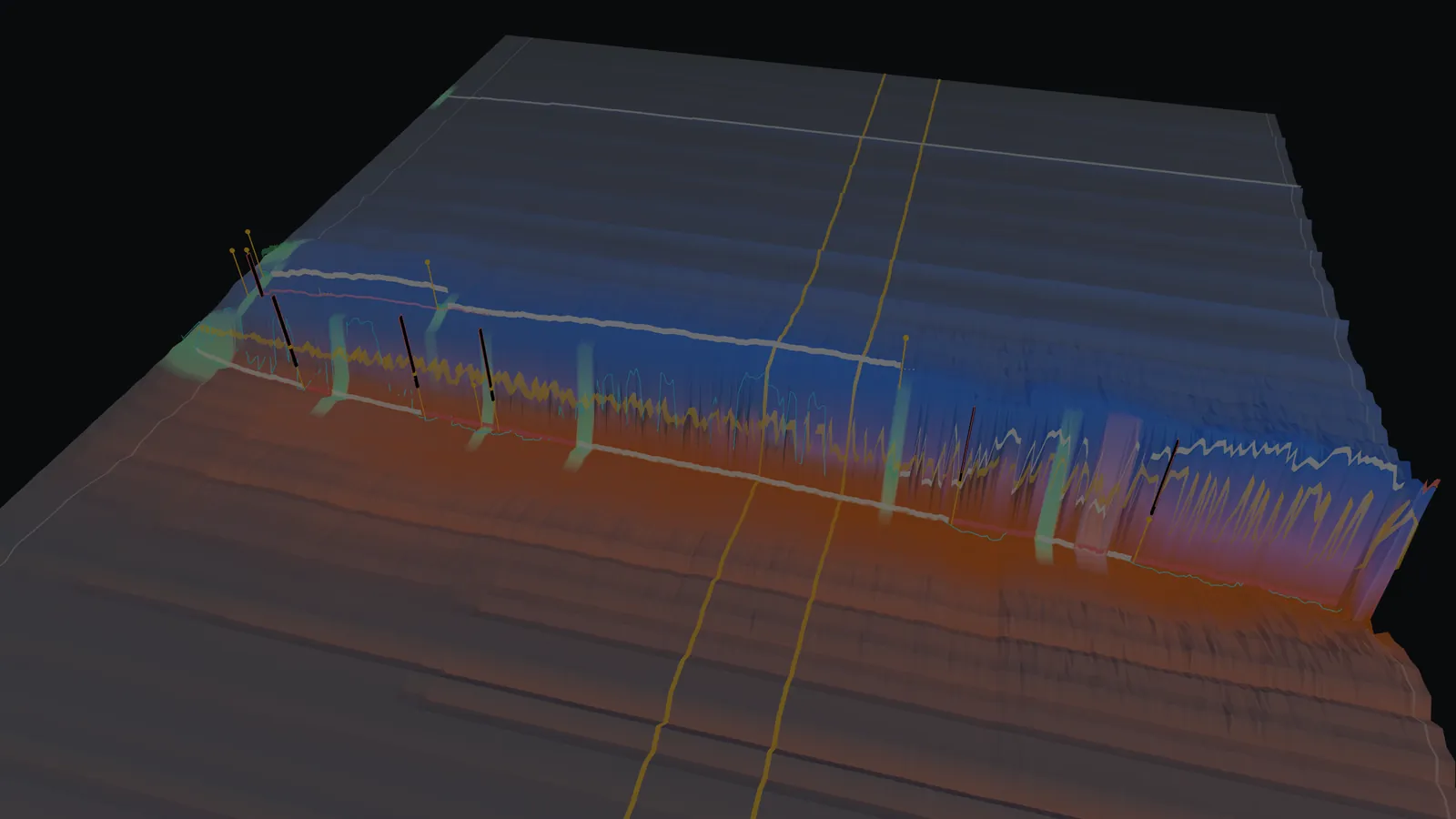
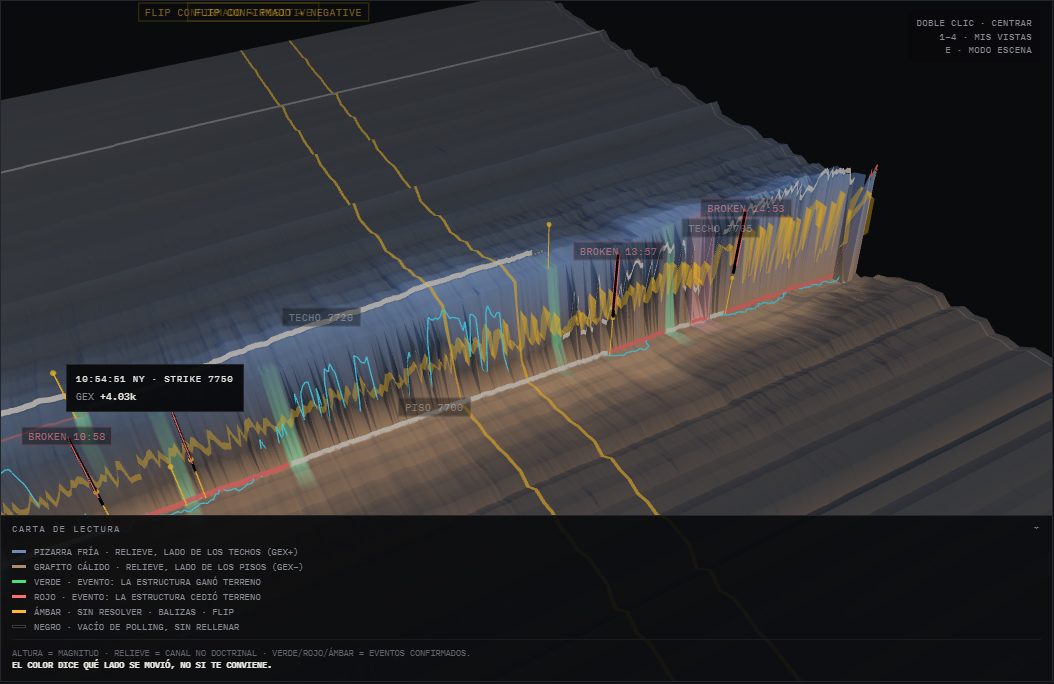
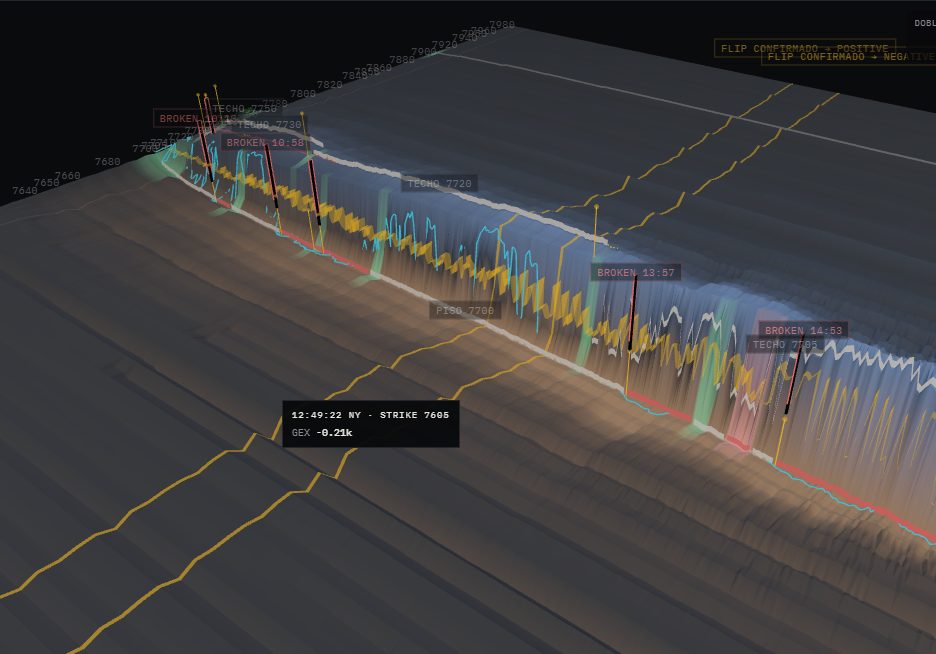
A strike × time terrain where height is GEX magnitude and color is doctrine. Each vertical column is an instant — one snapshot every ~60 s. Each horizontal row is a strike. The blue slope is the half of the book where dealers are long gamma; the copper slope, where they are short. Between them runs the zero gamma valley, and over all of it winds the cyan spot trace: the price walking through the force field.
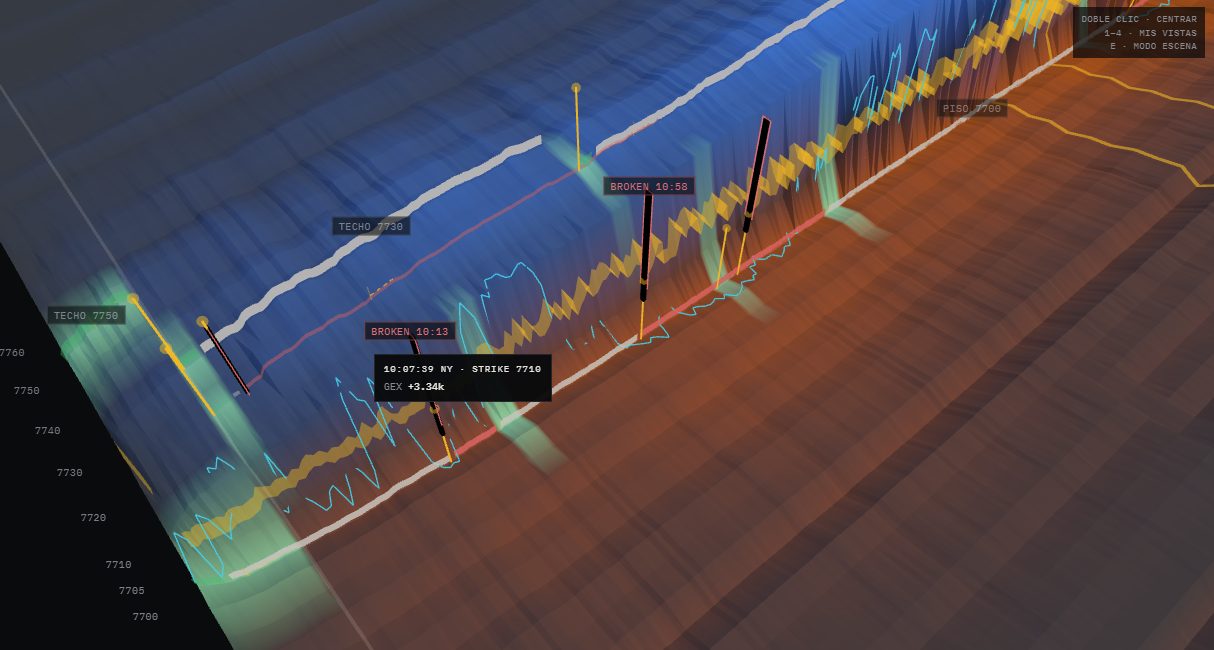
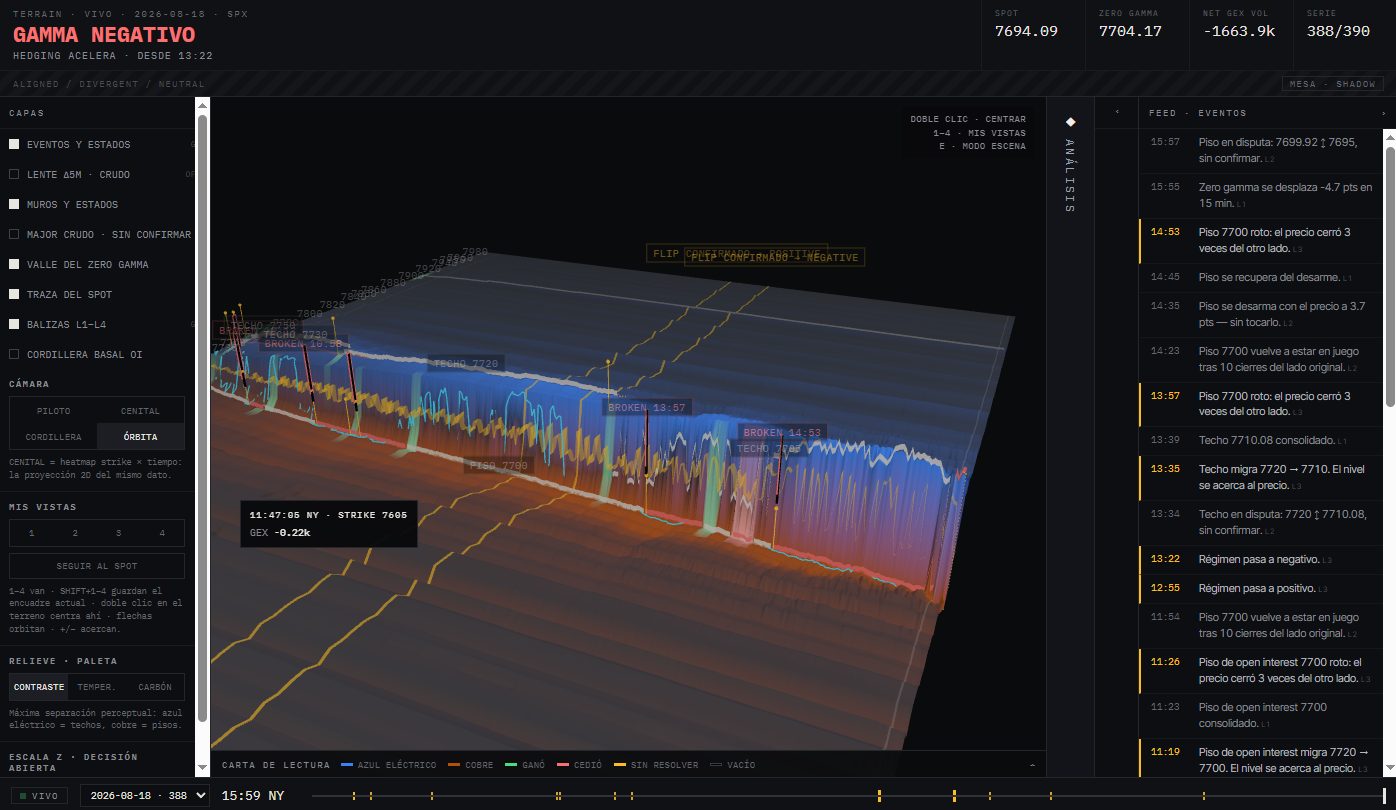
Events and states · Δ5m lens · walls · zero gamma valley · spot trace · L1–L4 beacons · OI base range. Every layer turns on and off at your discretion.
PILOT · OVERHEAD · RANGE · ORBIT. Overhead is the strike × time heatmap — the 2D projection of the same data. Double-click centers; 1–4 save your views.
Drag to travel through the session; the amber marks are events. LIVE takes you back to the present; ARCHIVE opens any complete historical session.
Walk the terrain.
One minute inside the scene, with no cuts or re-enactments: the orbit over both slopes, the flight skimming the blue crest, the overhead view and the return to the channel — with the session's events anchored to their exact minute. This is not a promotional render: it is the application, recorded in a real session.
A wall is not a line: it is a story.
NeuraGex tracks every level from birth to death — and remembers every transition. Each wall travels with its strength (f1–f3), its distance to spot and its duration in dual form: "HOLDING for 2 h 56 min (176 cycles)".
BUILDING
The level is accumulating GEX; it is being built. Young structure: its strength is not yet proven.
HOLDING
The level holds: the exposure is sustained over time. The "solid" state of the map — and duration matters.
BROKEN
The level was crossed or unwound. A recent BROKEN redraws the map: the neighbors inherit the spotlight.
How hedging breathes.
The gamma regime defines the physics of the session: whether dealers, as they hedge, slow the price down or push it along.
POSITIVE GAMMA
HEDGING STABILIZESSpot trades above zero gamma. Dealers, long gamma, sell rallies and buy dips to hedge: their flow dampens. Ranges tend to compress and walls tend to be respected more.
NEGATIVE GAMMA
HEDGING ACCELERATESSpot trades below zero gamma. Dealers, short gamma, buy rallies and sell dips: their flow amplifies. Moves extend and breaks meet less resistance.
Call up the analyst without leaving the scene.
A narrow rail lives on the right edge. Behind it, an analyst working on the exact moment you are looking at — the visible one, the one declared by the envelope's contract. If you move the scrubber, the contract follows you. With no moment on screen, it does not analyze the void.
The analogy engine finds the historical episodes most similar to the visible moment and reports what happened next — with the n always welded to the percentage: "held in 6 of 7 (86%)". A percentage without a sample size is propaganda, not measurement.
The state of the map at this instant: regime and its duration in dual form, walls with state/strength/distance, ceiling–floor channel, normalized net GEX, session health. When the present doesn't match history, the text says so.
The most important block — which is why it is framed, not in fine print. It declares the limits of the reading: what is a past episode and not a projection, which similarity is not identity, which windows have no data. Epistemic limitation gets top billing.
Three AI agents sit down at a table.
The moment you invoke the analysis, three agents sit down to deliberate on the exact instant you are looking at. On the table: institutional flow in dollars — billions in gamma exposure. Each agent reads its own share — the map, the flow, the record — and a single verdict comes out of the table. Based on measured history, not opinion.
Why agents that are partial by design? A single analyst with all the data averages out its own internal tensions and delivers a smooth synthesis. Two agents that cannot see each other's data produce truly independent readings — and when they clash, the clash is information.
THE STRUCTURALIST
Seat 1 · receives only the static mapWalls, states, strengths, regime, durations. It reads the snapshot. It cannot speak to flow because it never receives it — the partiality is by data type, not by instruction.
THE FLOW READER
Seat 2 · receives only the derivativesGEX changes per window (w5/w15/w30), zero gamma migration, net GEX velocity, transitions. It reads the recent work. It knows nothing of states or strengths: it cannot claim what it does not receive.
THE COUNSELOR
Seat 3 · receives both readings + the settled cross-checkWrites the verdict. Rule six: it does not invent, does not break ties, does not soften. If there is a dispute, it opens with the dispute. If a voice declared a data point unavailable, it must raise it.
The dispute is not declared by a language model: it is declared by an algorithm.
The deterministic cross-check compares the two fact packages and requires three conditions at once to flag divergence. If you change the prose without changing the data, the cross-check does not change — this is tested.
How to read a verdict.
The dispute that preceded the break.
Session of August 17, 2026, SPX, negative regime since 11:40. Three real Council records, in sequence, exactly as they were persisted. This is what the instrument looks like at work.
The Structuralist: floor 7770 HOLDING for 2 h 56 min, strength f3 — the most solid on the map. The Flow Reader: sustained withdrawal right on that wall, deepening from −0.078 to −0.227 of total GEX across the windows. The map says solid; the flow says it is being unwound. The Counselor opens with the dispute and does not break the tie.
Both walls ended up above spot — "somewhat atypical", says the record. 7770 has been BROKEN for 32 min and the flow no longer works there: the voices converge that the event happened. Convergence on the new structure, not on the old one.
Floor 7750 transitions to DECAYING — and the map and the flow report the same transition, at the same strike, in the same minute. The session ended giving up ground step by step; the Council narrated it at every stage.
Trust is not asked for: it is built with visible mechanisms.
These are the ones at work in every reading that reaches your screen.
Overhead-first: the map never gives way.
When you invoke an analysis, the drawer pushes the feed and the scrubber — never the heatmap. The map is the only thing that never gives up space, on any platform. The analysis exists to serve the scene, not to cover it.
Tapping a citation pans the overhead view to its coordinate — the answer is read on the map, not in the panel. ■ BACK restores the pan; the terrain stays the protagonist.
AA contrast verified per pair, touch targets ≥44 pt, text always legible. Legibility is not negotiated by screen size.
Choose your depth.
Honest pricing for an honest product: you pay for measurement with memory, not for promises.
- The full live 3D terrain, 60 s cadence
- Walls, states, regime and L1–L4 beacons
- Historical session archive with scrubber
- Overhead-first mobile view
- The full doctrine: structural color, stale data, gaps in plain sight
- All of TERRAIN Core, plus:
- On-demand analysis with precedents from the corpus — the n always next to the percentage
- The full Council: the voices, the cross-check and the verdict by axis
- Anchored citations that fly the camera, and auditable records of every reading
Prices in USD, taxes included: the price you see is the price you pay, wherever you are.
A notice we prefer to repeat: NeuraGex is a positioning analysis tool. It is not financial advice, it does not issue investment recommendations and it guarantees no outcome whatsoever. Trading futures and options involves substantial risk of loss. The decision — and its risk — is always yours.
Use the instrument in your real sessions and decide whether the reading makes you a better reader of the market.
8 days of the plan you choose, Core or Pro. A live terrain, a public doctrine and a system that would rather tell you "this cannot be claimed" than fill the silence with manufactured confidence.